 DE
DE EN
EN FR
FR ES
ES PT
PT AR
AR RU
RU
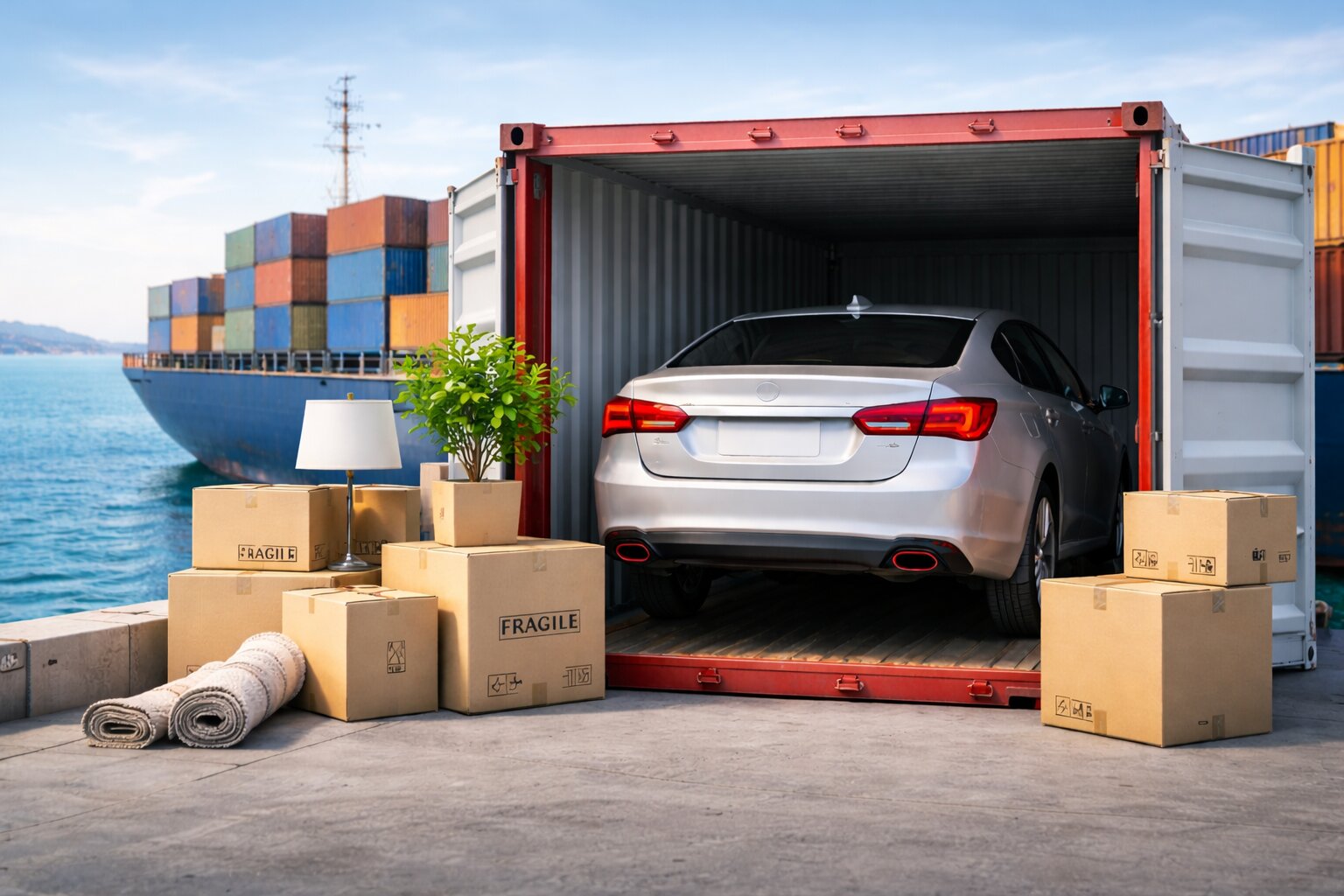
Anyone moving their center of life from a non-EU country to Germany often faces the question: What happens to their own vehicle? The good news is that you can import your car as household goods duty-free, provided certain conditions are met. This eliminates both the regular customs duty of ten percent and the import VAT of 19 percent – a significant financial relief. This article shows you which requirements apply, which documents you need, and how the customs clearance process works. This way, you can transfer your vehicle to Germany legally and cost-effectively.
What does “household goods” mean for vehicle import?
In customs law, the term “household goods” describes all personal items that you bring with you when permanently moving from a third country to the European Union. This includes household effects, furniture, personal valuables – and also private vehicles. The legal basis is the European customs exemption regulation, specifically Article 3 et seq. This regulation makes it possible to bring a vehicle as household goods into free circulation without import duties.
It is important to distinguish this from regular vehicle imports. If, for example, you buy a car in the USA or Canada and ship it to Germany without moving yourself, different rules apply. In this case, ten percent customs duty on the vehicle’s value is due, plus 19 percent import VAT on the total amount. For a vehicle value of 30,000 euros, this quickly adds up to more than 9,000 euros in duties. Importing a vehicle as household goods saves you these costs entirely – provided you meet all conditions.
Requirements for duty-free import
To import a car as duty-free household goods, you must meet several criteria. First, your usual place of residence before the move must have been outside the customs territory of the European Union for at least twelve months. This requirement serves to distinguish actual relocations from short-term stays abroad. Exceptions are possible if you can prove that you originally intended to stay abroad for at least one year – for example, through an employment contract.
The vehicle itself must belong to you and have been registered in your name for at least six months. This is proven by foreign registration documents such as the Certificate of Title or comparable papers. After moving your residence, you have twelve months to register the car as household goods. Another important restriction concerns resale: the vehicle may not be transferred to third parties within the first twelve months after import. Violations of this condition can lead to the subsequent collection of import duties.
These documents are required for customs declaration
Careful documentation is crucial for successful customs clearance. Fundamentally, you need a registration certificate from the German registration office, confirming your new place of residence. Equally important is the deregistration certificate from the country of origin, proving that you have given up your residence there. The original vehicle documents – such as the American Certificate of Title or the Canadian Vehicle Registration – document your ownership of the vehicle and the duration of registration.
For the formal registration, you use customs form 0350, which is specifically intended for the transfer of household goods into free circulation. In addition, customs requires proof of your actual stay abroad. This includes, for example, employment contracts, rental agreements, bank statements, or electricity bills from the country of origin. The more completely you can prove the twelve-month stay, the smoother the clearance process will be. Collect these documents early to avoid delays.
Customs clearance process for a car as household goods
Customs declaration for a car as household goods usually takes place at a border customs office or an inland customs office. If vehicles arrive in Germany by ship – for example, via the port of Bremerhaven – a receiving agent often handles the initial processing. Alternatively, you can make the customs declaration directly at the border crossing if you bring the vehicle yourself across the land border. The customs officer checks your submitted documents and compares the information with the actual vehicle.
After successful inspection, you will receive the so-called customs clearance certificate. This document is essential for the subsequent registration of the vehicle with the German vehicle registration office. A special rule applies to early imports: If you want to bring the vehicle to Germany before your official relocation, this is possible. However, customs will then require a security deposit, which you will receive back as soon as you actually establish your residence in Germany within six months.
Vehicle tax and other costs – what still applies
The customs exemption for household goods explicitly does not extend to all duties. German vehicle tax is levied directly during customs clearance and must be paid one year in advance. The driver submits a tax declaration to the border customs office, and payment is due immediately. The amount of the tax depends on the engine capacity and emission class of the vehicle – for vehicles with large engine capacities without European emission classification, this burden can be considerable.
In addition to vehicle tax, other costs arise. For registration in Germany, the vehicle requires a technical inspection, the so-called main inspection (Hauptuntersuchung). The fees for this range between 100 and 200 euros, depending on the inspection organization and effort. There may also be conversion costs, for example, for adapting the lighting to European regulations, as well as the regular registration fees at the authority. Plan these additional costs into your budget, even if customs and import VAT are waived.
Advantages for technical registration as household goods
An often underestimated advantage concerns the technical side. If the vehicle was registered in your name abroad for at least twelve months and is to be registered in your name again in Germany, simplified conditions apply to the main inspection. The registration authorities can grant exemptions that would not be available for regular imports. This particularly concerns the proof of exhaust gas behavior according to European standards.
For a normal vehicle import, without appropriate documentation, a complex and expensive measurement on the exhaust gas test bench must be carried out. For vehicles imported as household goods, this proof can be waived. The competent authority instead grants an exemption during the registration process. This simplification not only saves money but also time and nerves. However, please note that the exact regulations may vary between the federal states. Therefore, it is advisable to consult with the local registration office before importing.
Car as household goods – your forwarding agent supports you
The complexity of customs clearance and the multitude of required documents can quickly seem overwhelming. As an experienced international forwarding agent, we relieve you of this burden and accompany you through the entire process. From collecting the vehicle in the country of origin to shipping and customs clearance in Germany – all steps are professionally coordinated. This minimizes the risk of delays or problems during customs clearance.
As specialized service providers, we have many years of experience with international vehicle imports and are familiar with the specifics of the household goods regulation. We prepare the necessary customs documents, communicate with the authorities, and ensure smooth processing at the port of destination. Our expertise not only saves you time but also protects you from costly mistakes. Especially for valuable vehicles or complex relocation situations, professional support is a worthwhile investment.
Conclusion – Duty-free car import when moving to Germany
Being able to import a car as household goods duty-free offers significant financial advantages for anyone permanently relocating to Germany. With the right preparation and complete documentation, the process can be successfully managed. Crucial factors are the stay abroad for at least twelve months, the vehicle registration in your name for six months, and timely import within one year of moving your residence. While vehicle tax and technical inspection costs still apply, the savings are considerable compared to regular import duties.
Plan your vehicle import early and collect all necessary proofs during your stay abroad. For questions about the specific process or the transfer of your vehicle, specialized logistics service providers are at your disposal. Contact us for individual advice – together we will find the optimal solution for your move to Germany.