 DE
DE EN
EN FR
FR ES
ES PT
PT AR
AR RU
RU
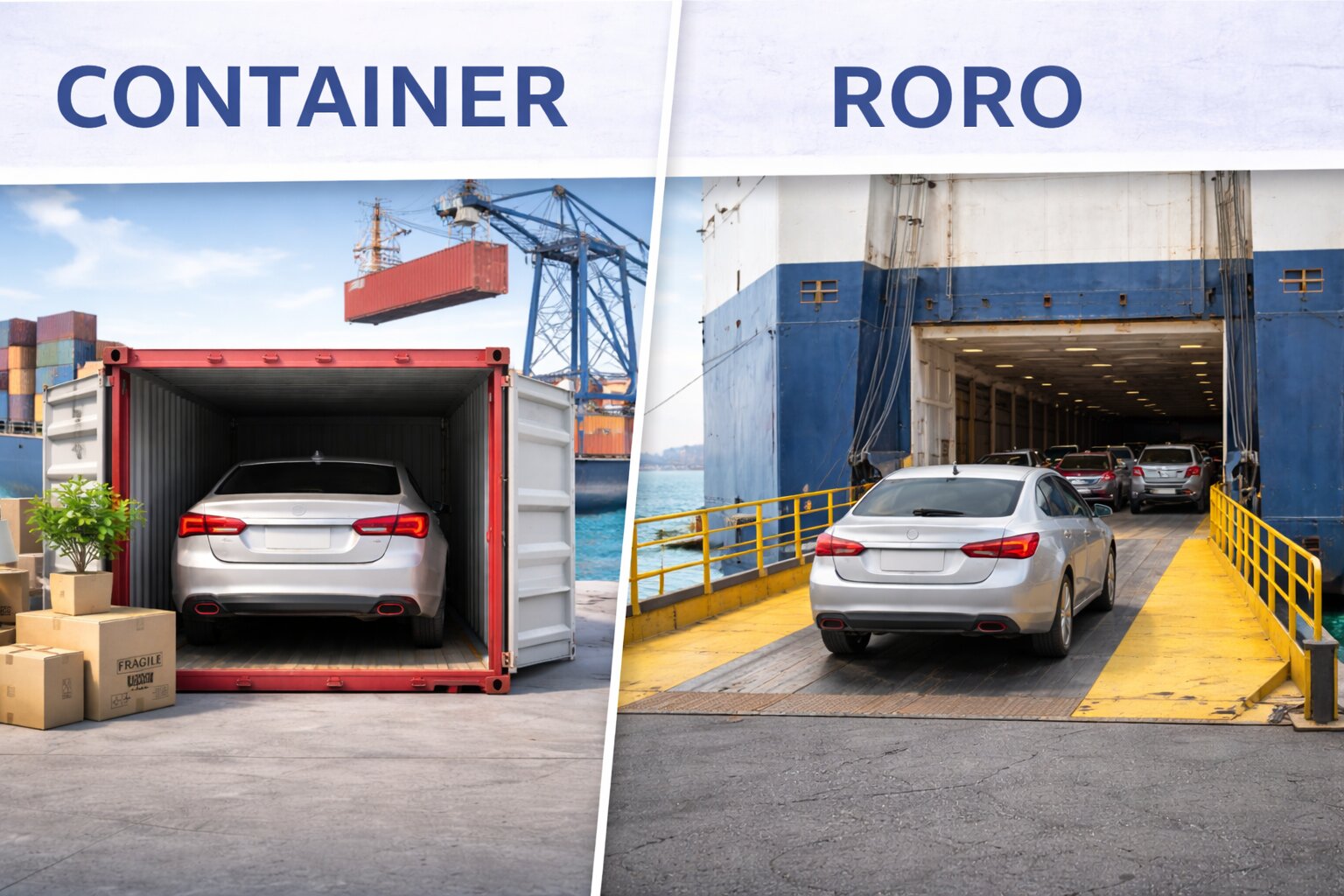
The international vehicle transport presents you with important decisions that have a significant impact on costs, safety, and time. Two established methods dominate sea freight: container shipping and the RoRo procedure. Both transport methods differ fundamentally in their functionality and are suitable for different requirements.
The choice between container vs. RoRo depends on numerous factors. Vehicle condition, budget, transport duration, and need for protection play a central role. A roadworthy standard vehicle requires different conditions than a valuable vintage car or a non-functional machine.
This guide provides you with sound knowledge about both shipping methods. You will learn which type of transport is best suited for your project and what you should pay attention to when making your decision. With this overview, you will make an informed choice that meets your individual requirements.
What is Container Shipping?
Definition and Functionality
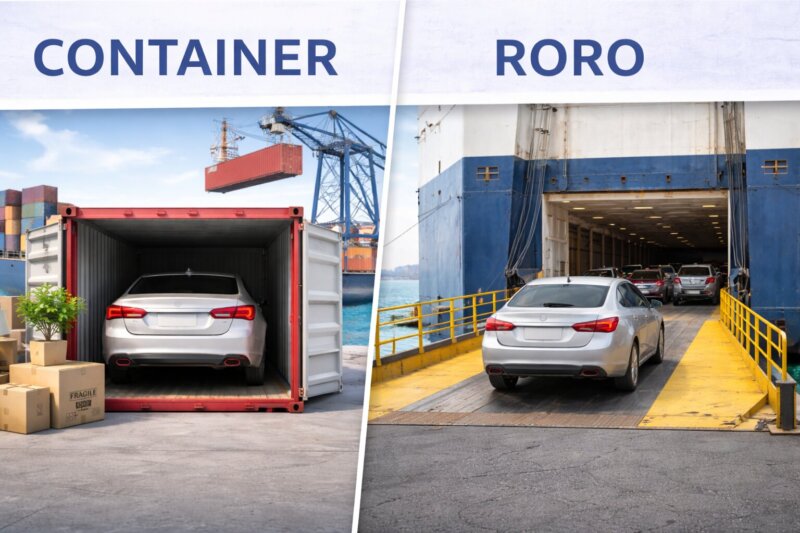
In container transport, your vehicle or freight is stored in standardized metal containers. These containers mainly exist in two sizes: 20 feet (about 6 meters) and 40 feet (about 12 meters) in length. Heavy-duty cranes lift the sealed units onto cargo ships, where they are stacked and secured.
The loading process is systematic. Specialized personnel fix the vehicle in the container with special straps and wedges to prevent movement during transport. The container is then closed and sealed. This method ensures that no one has access to the contents during the sea voyage.
Two variants are available: Full Container Load (FCL) and Less than Container Load (LCL). With FCL, you use the entire container exclusively, while with LCL, several shippers share the available space. The second option significantly reduces costs but requires additional coordination during loading and unloading at special transshipment points.
For which transports is container shipping suitable?
Non-roadworthy vehicles can only be transported in containers. This applies to project vehicles under construction, accident vehicles, or machines with defective drives. The closed design allows for safe transport regardless of the technical condition of the goods.
Vintage cars and collector vehicles particularly benefit from comprehensive protection. Restored classics with sensitive paintwork, rare models, or historic vehicles require maximum security from weather influences. Salty sea air, rain, and sunlight can cause damage during open loading, requiring expensive rework.
Another advantage is evident in the transport of additional goods. Spare parts, personal belongings, or accessories can be placed in the remaining container space. This possibility makes the method particularly economical if you want to ship other items in addition to the vehicle. However, strict customs regulations apply, requiring detailed documentation of all accompanying items.
What is RoRo Shipping?
Definition and Functionality
RoRo stands for “Roll-on/Roll-off” and describes a transport method where vehicles drive independently onto specialized ships. Cars, trucks, or machines enter the ship’s interior via massive ramps, where they are parked in large cargo decks and secured with lashing. At the destination port, the vehicles leave the ship the same way.
These ships have several decks with spacious parking areas. The construction resembles multi-story car parks on the water. Hydraulic ramps provide direct access to all levels, so even heavy vehicles can be easily brought on board.
The entire process is significantly faster than container transport. Crane work, packaging, and complex cargo securing are eliminated. Drivers steer the vehicles directly to the designated parking spaces, where they are lashed down. This efficiency reduces port layovers and significantly speeds up processing. However, the vehicles remain exposed to the weather conditions on the open sea throughout the entire crossing.
For which transports is RoRo shipping suitable?
Roadworthy vehicles of all categories are ideally suited for RoRo transport. Cars, motorcycles, trucks, and buses can use this method, provided they can drive onto the ship under their own power. The engine must function, the brakes must work, and the steering must operate perfectly.
Large and bulky goods find their ideal solution in the RoRo method. Motorhomes, which do not fit into standard containers due to their dimensions, can be loaded without problems. Construction machinery such as excavators, wheel loaders, or forklifts also use this route. Agricultural vehicles – from tractors to combine harvesters – are regularly shipped this way.
For oversized items, RoRo often offers the only practical alternative. Special vehicles, heavy equipment, or exceptional transports would exceed container limits or cause disproportionately high costs. The open cargo decks of RoRo ships can handle almost any dimension. However, you must note that the tank may only be filled to a maximum of one-quarter, and personal items are not allowed in the vehicle.
Container vs. RoRo: The most important differences in direct comparison
Costs
| Kriterium | Container | RoRo |
|---|---|---|
| Startpreis pro Fahrzeug | ab 1.050 € | ab 900 € |
| Sammelcontainer | ab 500 € (geteilt) | not available |
| Port Fees | higher (crane, terminal) | niedriger (direkte Verladung) |
| Handling-Kosten | aufwendig | minimal |
The pricing when comparing container vs. RoRo shows clear differences. RoRo remains the cheaper choice for roadworthy standard vehicles, as crane work, packaging, and complex cargo securing are eliminated. This saving is particularly noticeable for individual transports.
However, the price advantage for shared containers is significantly relativized. If you share a 40-foot container with up to three other vehicles, the costs decrease by more than 50 percent. This variant often reaches a similar price level to RoRo but offers significantly more protection. Additional costs such as fuel surcharges, seasonal surcharges, or security fees apply equally to both methods. The final costs depend heavily on the route, season, and current market situation.
Safety and Protection
Containers offer unparalleled protection against weather influences, theft, and mechanical damage. Your vehicle remains in a sealed steel box throughout the journey, protected from salty spray, rain, and UV radiation. Only authorized personnel have access during loading and unloading – this closed system drastically minimizes the risk of damage.
RoRo transports expose vehicles to the elements. On open decks, spray, wind, and weather hit parked vehicles unfiltered. Salt crystals settle on paint and underbody, which can lead to corrosion problems on sensitive surfaces. In addition, there is an increased risk of theft during port layovers, as vehicles remain accessible.
Insurance options reflect these differences. Container transports allow for comprehensive policies that cover almost all damage scenarios. Detailed handover protocols document the condition at loading and unloading, which facilitates claims processing. RoRo insurance is often limited to total loss, as proving partial damage is difficult. Minor scratches or dents can hardly be clearly attributed in time, which complicates claims settlement.
Transport Duration and Availability
Container ships serve far more routes with higher frequency. On important routes between Europe and Asia or America, several ships operate daily. This tight schedule allows for flexible bookings and short waiting times until the next available departure date. Container ports exist worldwide in large numbers, making virtually any destination accessible.
RoRo connections are limited to selected main routes. Specialized ships operate between Europe and North America or the Middle East, but with significantly lower frequency. Two to six departures per month are typical, which can mean longer waiting times. Many smaller ports do not have RoRo infrastructure, which limits the destination options.
The actual crossing duration hardly differs between the two methods. Both types of ships take about three to four weeks for transatlantic routes. The difference is evident in loading and unloading: RoRo vehicles often leave ports within a few hours of arrival. Containers require crane work, customs clearance, and transport to the container terminal, which can extend the total duration by several days.
Flexibility
Containers score with worldwide availability and multimodal applicability. After arrival at the seaport, the container can be transported by rail or truck to its final destination without transshipment. This seamless integration of different modes of transport enables door-to-door deliveries even to remote regions.
Port infrastructure plays a crucial role. Container cranes can be found in virtually every major port worldwide, while RoRo ramps require special facilities. Smaller ports, especially in developing countries or remote areas, rarely have RoRo capacities. This limitation significantly restricts your destination options.
The vehicle condition largely determines the available options. A defective engine categorically excludes RoRo – the vehicle must be able to roll onto the ship independently. Containers accept any condition: disassembled vehicles, accident vehicles, or restoration projects can be loaded without problems. This flexibility makes containers the only choice for technical problems. Conversely, RoRo offers more spontaneity, as no container reservation and provision is required.
The Advantages of Container Shipping
Maximum Protection and Security
Containers represent the gold standard for maximum protection. Your vehicle rests in a completely sealed steel box, shielded from all environmental influences. Saltwater, which splashes over decks during rough seas, does not reach the interior. Sunlight cannot fade paint, rain cannot carry moisture into the interior.
Independence from Vehicle Condition
Non-drivable goods can only be transported across the oceans in containers. Defective engines, broken axles, or missing tires are no obstacle. Even completely disassembled vehicles or restoration projects can be safely stowed.
Utilize Additional Storage Space
The available additional space in the container creates significant added value. Spare parts, tools, or personal belongings travel together with the vehicle. For relocations or long-term stays abroad, this reduces separate shipping costs. Insurance offers for container transports cover more comprehensive risk scenarios. Detailed damage protocols and clear chains of responsibility facilitate regulations. The worldwide availability of container ports guarantees flexible route planning and frequent departures, which creates planning security.
The Advantages of RoRo Shipping
Convincing Cost Efficiency
Cost efficiency marks the most convincing advantage of RoRo transports. Especially for drivable standard vehicles, you pay significantly less than for comparable container options. This saving results from the reduced labor effort – no packaging, no crane costs, no elaborate cargo securing.
Fast Processing
The processing speed significantly surpasses container procedures. Vehicles roll directly onto the ship and just as quickly off again upon arrival. Port layovers are reduced to a few hours instead of several days. This efficiency means faster overall door-to-door transport times.
Ideal for Oversized Items
Oversized vehicles and special machinery can easily be accommodated on RoRo ships. Motorhomes several meters high, extra-wide construction machines, or extra-long commercial vehicles do not fit into standard containers. The spacious cargo decks can handle practically any dimension. The uncomplicated process requires minimal preparation. You drive to the port, specialist personnel assign you a parking space, the vehicle is lashed – done. This simplicity significantly reduces logistical effort and potential sources of error.
When should you choose containers?
Decision criteria for container shipping:
- Your vehicle is not roadworthy (defective engine, missing parts)
- You are transporting a vintage car or a valuable collector’s item
- Maximum protection against weather and theft is required
- Additional goods are to be transported along with it
- The destination port does not have RoRo infrastructure
- Comprehensive insurance options are desired
Vehicles that are not roadworthy absolutely require container transport. If the engine does not start or essential components are missing, there is no alternative. This situation applies to accident vehicles, restoration projects, or defective machines.
Vintage cars, classics, and collector vehicles deserve maximum protection. For valuable or rare models, the higher investment is justified by risk minimization. Faithfully restored vehicles with delicate paintwork or historical rarities should not be exposed to weather conditions. Even brief exposure to saltwater can cause long-term damage. Destination regions without RoRo infrastructure necessitate choosing container shipping. Many smaller ports, especially in Africa, South America, or remote Asian regions, only have container terminals.
When should you choose RoRo?
Ideal conditions for RoRo shipping:
- The vehicle is fully operational and technically sound
- Budget plays a crucial role
- It is a standard vehicle without special collector’s value
- Quick processing is desired
- Oversized vehicles exceed container dimensions
- The destination port has RoRo facilities
Operational standard vehicles benefit optimally from the RoRo method. If your car, truck, or motorcycle functions perfectly and does not require special protection, you save significant costs. Everyday utility vehicles without special collector’s value rarely justify the higher container prices.
Budget often represents the decisive factor. With a tight budget, RoRo makes international transport possible in the first place. The difference between the two methods can amount to several hundred to thousands of euros – money you can invest elsewhere. Oversized cargo is exclusively transported via RoRo. Motorhomes, construction machinery, or large agricultural equipment significantly exceed container dimensions. Here, there is practically no alternative. However, check in advance whether the destination port has appropriate RoRo facilities.
Container vs. RoRo: Which method is right for you?
Vehicle type and technical condition form the first level of decision-making. An operational everyday car without special value protection is excellently suited for RoRo, while a restored classic or a defective vehicle requires a container. Objectively assess how sensitive your cargo is to weather and whether it can be moved under its own power.
Your available budget often determines the practical options. RoRo costs noticeably less, but containers offer significantly more security. Weigh whether the cost savings justify the higher risk. For valuable vehicles, potential repair costs after transport damage can quickly negate any savings.
The timeframe also plays a role. If time is pressing, RoRo offers advantages due to faster processing. If you have several weeks of leeway, containers allow more flexibility in scheduling. Check the port infrastructure at your destination. Not all ports have RoRo ramps, while container terminals exist almost everywhere. Your security requirements complete the decision criteria. Maximum protection, insurance options, and traceability speak for containers. Simplicity and cost-efficiency favor RoRo. Sound advice from logistics experts helps to optimally weigh all factors.
Global Logistic Group: Your partner for container and RoRo shipping
As Global Logistic Group, we possess comprehensive expertise in both transport methods. Our years of experience in international vehicle transport enable sound advice tailored to your specific requirements. Our expert staff analyze your situation and recommend the optimal solution.
Our worldwide network and established port connections guarantee smooth processes. Reliable partnerships with shipping companies, port operators, and customs authorities accelerate processes and avoid complications. This infrastructure allows us competitive prices through economies of scale and direct contractual relationships.
We offer you a complete service that includes all necessary steps from collection to delivery. Professional loading, cargo securing, and customs clearance are carried out according to our standardized quality processes. Our own storage facilities in Bremerhaven offer flexibility in schedules and allow for intermediate storage as needed. Transparent communication keeps you informed throughout the entire transport process. Regular updates on the current status of your shipment provide planning security. In the event of damage, our experienced teams support you with the settlement with insurance companies. Tailored solutions take into account special features such as oversized items, consolidated containers, or time-critical transports. This quality of service makes the difference between smooth processing and costly complications.
Conclusion
The decision between container vs. RoRo depends on numerous individual factors. Both methods have their distinct strengths and are suitable for different requirement profiles. Containers offer maximum protection, flexibility, and worldwide availability – ideal for valuable, sensitive, or non-drivable vehicles. RoRo scores with cost-efficiency, speed, and the ability to handle oversized cargo.
Your vehicle type, budget, timeframe, and destination form the basis for the decision. Drivable standard vehicles benefit from the favorable RoRo rates, while classic cars and special vehicles justify container protection. Check the port infrastructure at the destination beforehand and realistically calculate all costs.
Professional advice from experienced logistics partners helps to identify the optimal transport method. Specialized providers know the specifics of both procedures and can assess the advantages and disadvantages for your specific case. Get in touch to develop a customized solution for your international vehicle transport. With sound knowledge and competent support, your transport project will be a success – safely, on time, and cost-effectively.